
Painting Plymouth's cedar, stucco and hardboard homes
Plymouth's housing is a generation older than Rogers or St. Michael, and it shows in the materials. The 1970s homes are cedar lap and channel siding, often stained when new and now gray on the north side and silver on the south, with cedar trim and cedar decks that have gone the same way. That is staining work: wash, brighten where the wood has darkened, dry fully, and a solid or semi-transparent stain that soaks in. Where the cedar has been painted at some point, it stays painted and gets prepped as a painted surface. The 1980s brought stucco, and Plymouth has a lot of it: hairline cracks, chalking, and stains under the windows where water has run for decades. Stucco gets an elastomeric patch on the cracks, a masonry primer and a coating made for it, never a standard house paint. The late 1980s and 1990s homes are hardboard two-stories, the same siding we see all over Maple Grove, and they get the same treatment: a close look at the bottom courses, a bonding primer on every bare edge and nail head, and two coats in a satin that sheds water.
Painting homes near Medicine Lake and on wooded lots
Plymouth has mature trees the way the newer suburbs do not, and a lot of its homes sit on wooded lots with the exposure problems shade brings: damp north walls, mildew on cedar and hardboard, and peeling where the gutters overflow. Around Medicine Lake the water adds another wet wall. The lake-facing side of those homes sees dew and fog most mornings, and that is where we find peeling bottom courses, mildew and weathered deck boards. We wash with a mildewcide, give the shaded and lake walls an extra drying day, prime every bit of bare wood, and use a finish that handles wet-dry cycling. The Plymouth Creek area and the neighborhoods off Hwy 55 have the same mix of cedar and hardboard under trees. On all of them, we tell you when a limb over the wall is the real reason the paint keeps failing, because trimming it is cheaper than repainting again in three years.
Scheduling a painting job in Plymouth
Plymouth jobs start with a walkthrough, a written estimate and color samples on the house. Plymouth lots are closer together than the acreage cities, so we mask the neighbor's side as carefully as our customer's and keep the sprayer to walls where overspray can be controlled. Every exterior gets a written estimate, a wash, scraping and sanding where the surface needs it, caulk, primer and two finish coats sprayed and back-brushed on siding and brushed on trim, with daily cleanup and a final walkthrough. Exterior season runs roughly May to mid-October.
Exterior painting in Plymouth
Plymouth's cedar, stucco and hardboard each want a different exterior painting process, and picking the wrong one is how a Plymouth house ends up peeling in two summers. Our exterior painting page covers the process for each material, the staining and sealing work most cedar homes need, and what changes the cost on an older home under trees. How an exterior repaint goes, and what moves the cost.
Interior and cabinet painting in Plymouth
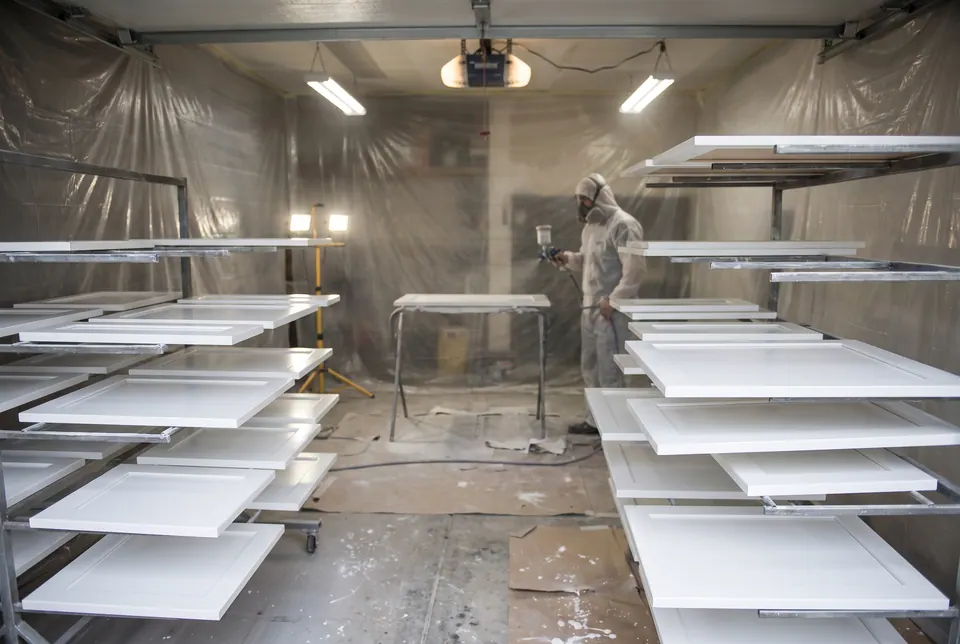
Inside, Plymouth's 1970s-90s homes are the winter job we do most: stained oak trim, stair rails and doors sprayed white, popcorn ceilings patched and repainted, and the original oak kitchen sprayed with a waterborne enamel. Many have a stone or brick fireplace wall that someone wants painted. We run interior and cabinet work November through April, a floor at a time. See interior painting and cabinet and trim enamel.
Neighborhoods we paint in Plymouth
- Plymouth Creek
- Medicine Lake area
Painting and repair services in Plymouth
Painting
Exteriors and build
Questions we hearCommon painting questions in Plymouth
Can you paint the stucco on our 1980s Plymouth home?
Yes, with the right products. Stucco gets the hairline cracks filled with an elastomeric patch, a masonry primer over the chalky and stained areas, and a coating made for stucco rather than a standard house paint. Standard paint on stucco peels because the surface breathes and moves. We wash and prime the streaks under the windows first so they do not bleed through the new coating, and a low-sheen finish keeps the texture looking natural.
Our Plymouth house has gray cedar siding. Stain or paint?
If it has only ever been stained, stain. We wash it, brighten where the wood has gone dark, let it dry, and apply a solid or semi-transparent stain that soaks in and does not peel. If someone painted it at some point, it has to stay painted, and we prep it as a painted surface. We check on the walkthrough and tell you which one you have. Most 1970s Plymouth cedar we see is stained and ready to be brought back.
Do you work on Medicine Lake homes?
Yes. The lake-facing wall gets a mildewcide wash, an extra day to dry, a bonding primer on every bit of bare wood and a finish chosen for wet-dry cycling, all scheduled for the driest days of the job. Any soft sill or trim board we find during prep gets replaced before the finish goes on.