
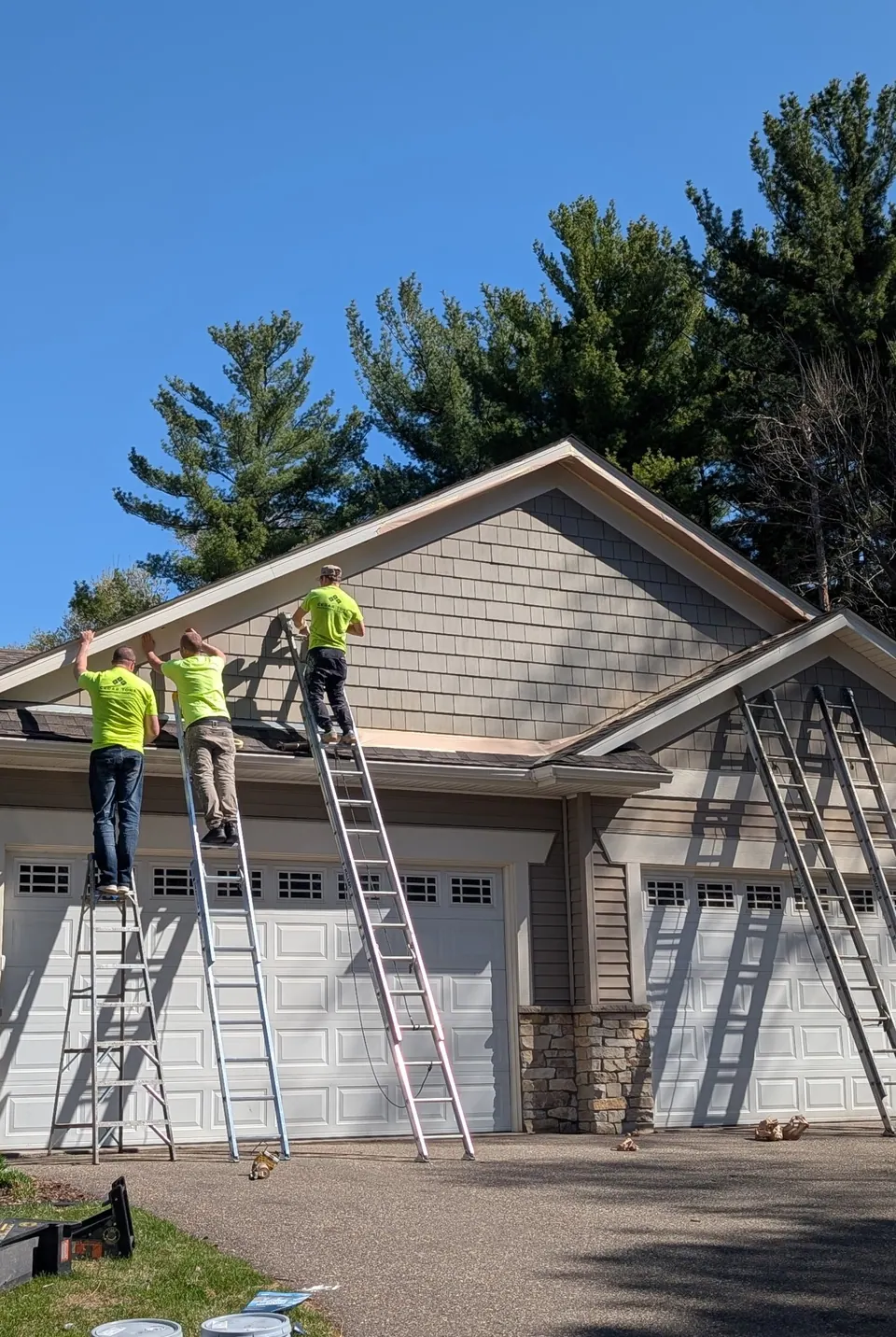
What's included in every exterior painting job
Every exterior job starts with a walkthrough. We go around the house with you, look at how the old finish is holding up on each side, and write an estimate that lists the surfaces, the prep and the coat count, so you can see where the time goes. On the first day the crew washes the house to get pollen, chalk and mildew off the siding, then lets it dry. Next we scrape anything loose and sand the edges so the old paint feathers into the bare spots instead of leaving a ridge that shows through two coats. Any soft trim we find during prep gets replaced before primer, and it shows up on the estimate as its own line. Gaps at casings, corner boards and butt joints get caulked, and bare wood gets a primer matched to what it is: a stain-blocking primer on cedar so the tannins do not bleed through a light color, and a bonding primer on chalky old paint and steel doors. Before any paint goes on, we mask the windows, the roofing at the drip edge, light fixtures and brick, and cover the plantings along the foundation. Then the whole house gets two finish coats of premium exterior paint. On siding we spray and then back-brush, which pushes the paint into the grain and the lap joints instead of leaving it sitting on the surface. Trim, doors and shutters are brushed, which is how you get a sharp line where the trim color meets the body color. We clean up every day, pull the masking, and walk the house with you at the end. Reviews on Google mention the things we care about most: masking that protects the roof and windows, clean cut lines, matched colors, and a crew that shows up when it said it would.
- Written estimate with surfaces, prep and coat count spelled out
- Pressure wash, scrape, sand and feather every edge
- Caulk at casings, corner boards and joints, with primer matched to the surface
- Windows, roofing, brick and plantings masked or covered
- Two finish coats, sprayed and back-brushed on siding
- Trim, doors, shutters and garage doors brushed, with daily cleanup and a final walkthrough
Why exterior paint fails in Minnesota, and where it starts
Paint on a Minnesota house does not wear evenly, and knowing where it fails tells us where to spend the prep time. The south and west walls take the full afternoon sun from May through September. That is where the color fades first and where the top coat chalks and thins, so a house that looks fine from the street can be down to primer on the back. Chalky paint has to be washed hard and often primed with a bonding product, or the new coat sits on powder and lets go. Freeze and thaw does the rest. Water gets behind a hairline crack in the caulk at a window casing, freezes, and pries the paint off in flakes, which is why most peeling starts at joints and end grain rather than in the middle of a lap. That is the reason we recaulk the joints and brush paint into the end grain of the trim instead of spraying past it. Ice dams push meltwater down behind the fascia and soffit, and the paint there blisters before anything else on the house does, so those runs get extra scraping and a full coat of primer. The north side rarely dries out under the trees, so it grows mildew and green algae that has to be washed off and killed before paint will stick. And the west metro gets its share of hail. A hail storm leaves dents and cracked paint on hardboard and cedar, chips on painted steel doors, and can crack fiber cement corners, so we look for that during the walkthrough and photograph it in case your insurance is involved.
- South and west walls: sun fade, chalking, thin top coat
- Joints, casings and end grain: freeze-thaw peeling
- Fascia and soffit behind ice dams: blistered paint
- North side under trees: mildew and algae
- West-metro hail: dents, cracked paint, chipped steel doors
Painting the siding we see most in the northwest metro
The northwest metro was built in waves, and each wave used a different skin, which changes how we prime and paint it. Houses from the 1970s through the early 1990s in Plymouth, Maple Grove, Medina and the older parts of Buffalo and Delano tend to wear cedar or hardboard lap siding. Cedar takes paint well when it is dry and clean, but any bare spot needs a stain-blocking primer or the tannins in the wood will brown out a white or a light gray. Hardboard soaks up paint at the bottom edge of every lap, so we brush that edge and make sure it gets both coats. Subdivisions from the late 1990s and 2000s in Rogers, St. Michael, Albertville, Otsego and Corcoran used a lot of LP SmartSide and similar engineered lap. It holds paint for a long time and it is the easiest siding to spray and back-brush evenly, but it should be recoated before the factory finish wears through at the joints. Then there is painted vinyl. We paint vinyl siding more than you might expect, sometimes because a previous owner painted it and the finish is uneven. It works with a vinyl-safe color no darker than the original, so the siding does not absorb heat and warp. Fiber cement corners and trim take paint well after a wash, with a bonding primer on any bare cut edge. And on older cedar homes the question is often paint or stain, which we cover on the staining and sealing page.
When we paint exteriors, and how the schedule fills
Exterior paint needs the surface and the overnight air above about 50 degrees to cure the way the manufacturer intends. In this part of Minnesota that gives us a window from early May to roughly the middle of October, with the shoulder weeks depending on the forecast. Because the season is short, we book it in order. Spring calls get spring and early summer dates, and by August the calendar is usually into September. If you call in March, you are near the front of the line and can pick your month. If you call in July, you get a firm date, even when that date is next season. Rain days push the schedule back a day, because we do not paint wet siding. Within a day we follow the shade where we can, working the east side in the morning and the west side in the afternoon, so we are not laying paint on a wall the sun has been baking for hours. Colors should be settled before your start date. We brush sample patches on the house so you can look at them in morning and evening light, since a body color that looks pale on a chip can read much darker across a whole wall. Interior painting, cabinets and trim fill our winter, so if the exterior has to wait, we can still get the inside done first.
When exterior painting is not the right call
- Bare cedar you like the look of. Paint hides the grain for good, and getting back to natural wood later means stripping the whole house. We would point you to a semi-transparent stain, which we cover on the staining and sealing page.
- A house that was painted within the last two or three years and just looks dirty. A wash and a few spot touch-ups are a better spend than a full repaint, and we will say so at the walkthrough.
- Vinyl siding you want painted a much darker color. Dark paint on vinyl absorbs heat and the panels warp. We will show you the vinyl-safe range for the color you have in mind, and a lighter body with darker trim and a dark front door often gets the look you are after.
Why homeowners hire us for exterior painting
- Color help and sample patches on your own siding before any paint is ordered
- Primer matched to the surface: stain-blocking on cedar, bonding on chalky paint and steel
- Wash, scrape, sand, caulk and prime before the first finish coat
- Two coats sprayed and back-brushed on siding, brushed on trim and doors
- Masking that protects roofing, windows, brick and plantings
- Daily cleanup and a walkthrough with you before we leave
Our exterior painting process, step by step
Walkthrough and written estimate
We come out, go around the house with you, look at how the paint is holding up on every side, and leave a written estimate with surfaces, prep and coat counts. Color help is part of it if you want it.
Wash, scrape, sand and mask
The house gets washed and left to dry, loose paint is scraped and feathered, and windows, roofing, light fixtures and plantings are masked or covered before any primer goes on.
Caulk, prime and two coats
Joints caulked, bare wood spot primed, then two finish coats: sprayed and back-brushed on siding, brushed on trim, doors, shutters and garage doors.
Cleanup and final walkthrough
Masking comes off, the yard gets picked up, and we walk every side of the house with you. Anything you point at gets touched up before the job is closed out.
What does exterior painting cost in the northwest metro?
Every exterior estimate we write is built from the same handful of things, and we itemize them so you can see where the number comes from. The size and height of the house sets the base. A walkout two-story with a steep grade on the back takes more ladder and staging time than a rambler. Condition is the next lever: a house that needs a wash and two coats is a very different job from one that needs heavy scraping, sanding and a full prime coat on every sunny wall. Siding type matters, since cedar and hardboard take more prep and more paint than engineered lap, and a stain job is priced differently from paint. Trim count, number of colors, and whether shutters, garage doors and a deck are included all add hours, because every trim color is another brushed cut line. A body color change needs two full coats to cover evenly, where a same-color repaint over sound paint goes faster. We do not publish numbers because two houses on the same street can be far apart, but the estimate is written, and the walkthrough costs you nothing.
- Square footage, number of stories and how much of the house needs staging
- Condition: how much scraping, sanding and priming the old finish needs
- Primer: spot priming versus a full prime coat on chalky or bare siding
- Siding material: cedar, hardboard, engineered lap, fiber cement or vinyl
- Trim, shutters, doors, garage doors and railings included
- Number of colors and whether the body color is changing
- Access: grade, plantings, decks and roof lines the crew has to work around
Questions we hearCommon questions about exterior painting
Do you paint barns, garages and outbuildings?
Yes. We paint barns, pole buildings, detached garages and sheds along with houses. On tall buildings we work from a lift so the peak gets the same coverage as the walls you can reach from the ground. A recent example is a weathered red barn in Greenfield that we sprayed barn red with white trim. Photos of it are on our work page.
When is the right time of year to paint a house exterior in Minnesota?
May through mid-October. Exterior paint needs the surface and the overnight air above about 50 degrees, and in the northwest metro that window opens in early May and closes when the October nights turn cold. June through September is the safest stretch. Because the season is short, we book jobs in the order the calls come in, so a call in late winter gets you a choice of months.
How long does exterior paint last on a house in Minnesota?
Most houses here need repainting in the range of seven to ten years, and the south and west walls go first. Cedar and hardboard on the sunny sides can need attention sooner. Engineered lap siding holds paint longer but must be recoated before the finish wears through at the joints. Good prep and two full coats are what push a paint job toward the long end of that range.
Do you help pick exterior paint colors?
Yes, and it is part of the walkthrough if you want it. We bring color samples, talk through body, trim and door combinations that suit the house and the roof, and brush sample patches on the siding so you can see them in morning and evening light before anything is ordered. A color that looks right on a small chip often reads darker across a whole wall, so we test on the house first.
Do you spray or brush exterior paint?
Both. On siding we spray to get an even film quickly and then back-brush every pass, which works the paint into the grain and lap joints so it bonds instead of bridging. Trim, doors, shutters and garage doors are brushed. Spraying alone is fast but leaves paint sitting on top of the wood, and that is the job that peels in a few winters.
Can vinyl siding be painted?
Yes, with the right paint and the right color. Vinyl can be painted with an exterior acrylic made for it, in a shade no darker than the original panel color. Darker colors absorb heat and the siding warps. We have repainted vinyl homes where an earlier paint job was uneven, and the fix was a wash, a light sand and two coats in a vinyl-safe color.
Often paired with exterior painting
Where we offer exterior painting
Exterior painting is available across Greenfield, Independence, Delano, Corcoran, Buffalo, Medina, Rogers and St. Michael, and the rest of the west and northwest Twin Cities metro. See the full service area.