
What's included in every interior painting job
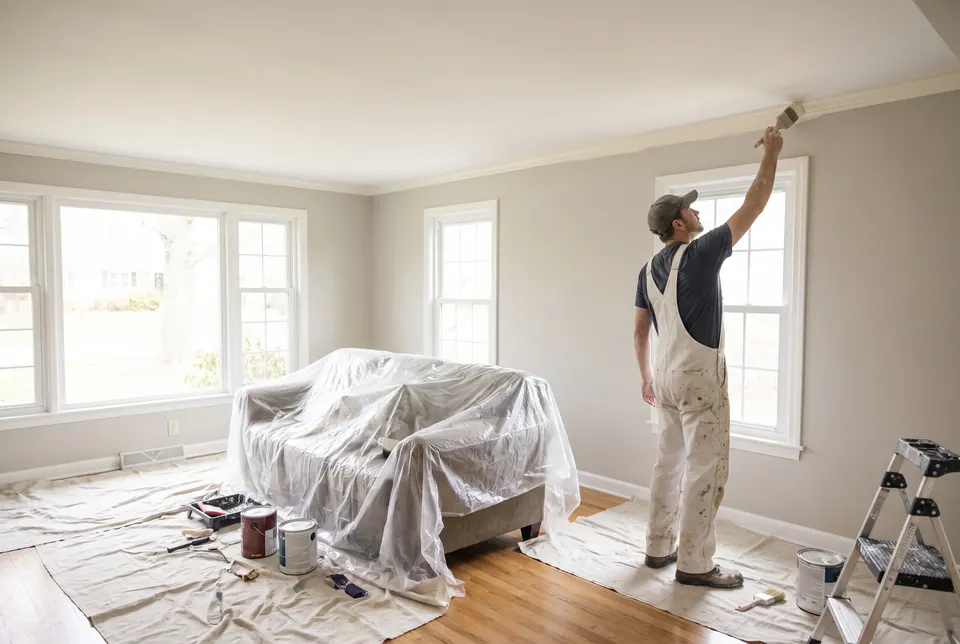
Interior painting is mostly prep, and the prep is what you are paying for. We move furniture to the middle of the room and cover it, mask the floors, and go over every wall with a light held at an angle to find the nail pops, dents and old patches that disappear under overhead light. Holes get filled, dents get skimmed and sanded flat, and anything we fill gets spot primed so it does not flash through the finish. Ceilings, walls and trim are done in whatever combination you want. We cut the ceiling line and the casings by brush and roll the walls in overlapping passes so the sheen reads even from across the room. A color change gets two coats. At the end of each day the room is vacuumed and the tools are out of your way, and before we load the van we walk each room with you and touch up whatever you point at. One reviewer had eight different colors through the house, and clean edges between them is the part she noticed.
- Furniture centered and covered, floors and fixtures masked
- Holes filled, dents skimmed, patches sanded and spot primed
- Ceilings, walls, trim and doors in any combination
- Cut lines brushed at ceilings, corners and casings
- Two coats on any color change
- Daily cleanup and a room-by-room walkthrough with you
Interior painting in winter, while you live in the house
The exterior season ends in mid-October, so from November through April our crews are inside, and that is the easiest time to get on the schedule. Winter has one quirk. Forced-air heat drops indoor humidity far below what paint labels assume, so paint flashes fast and lap marks show up if you stop halfway down a wall. We work in shorter sections, keep the wet edge moving and turn the thermostat down a couple of degrees in the room being painted. Low-odor waterborne paints let us work with the windows shut, which matters when it is below zero outside. Most of our interior jobs happen while the family is home, so we sequence rooms: bedrooms one day, the main floor the next, hallways and stairwells when traffic is lowest. You keep your bedroom until the last night. Kitchens get done between meals where we can. Pets are the one thing we ask you to manage, because a curious dog and a wet baseboard do not mix. One customer wrote that we helped move a few pieces of furniture and that it made the whole job easier. That is normal for us.
Painting oak trim, textured ceilings and other common requests
Much of the housing stock between Rockford and Maple Grove went up from the late 1980s through the mid 2000s, and it shares some traits. Honey oak trim, doors and railings were standard, and painting them white is one of the most common calls we get. It works, but it is not a coat of wall paint: the trim gets degreased, scuff sanded, bonding primed and finished with two coats of waterborne enamel, and the grain still shows through unless we fill it, which we will tell you before you decide. See our cabinet and trim enamel page for the full method. Knockdown and popcorn ceilings from the same years drink paint. They need a thicker roller nap or a sprayer, more material, and a flat finish, or every roller line shows. Builder-grade flat on newer walls in Otsego, Albertville and St. Michael flashes badly when you touch it up, so a full coat is often the only way to get an even wall. None of this is a problem. It just has to be in the estimate.
- Oak trim to white: degrease, scuff, bonding primer, two coats of enamel
- Textured ceilings: sprayed or thick nap, flat finish only
- Builder flat: touch-ups flash, plan on a full coat
Wallpaper removal and ceiling stains, handled before painting
Two jobs come with almost every older house we paint inside, and both have to be done right before the first finish coat goes on. The first is a ceiling stain from an old ice dam, a bathroom leak or a washer hose. Ordinary ceiling paint will not hide it, because the stain bleeds back through the new coat. Once the water source is fixed and the drywall is dry, we patch any damaged spot, match the knockdown or popcorn texture around it, and seal the whole stain with a stain-blocking primer. Then we roll the entire ceiling, wall to wall, because a ceiling painted only around the spot shows a halo when the light comes through the window. One customer described it as water damage on the basement ceiling that we repaired and textured, and that is exactly the job. The second is wallpaper. Paper from the 1980s and 1990s comes off in layers, and the paste underneath has to be washed off completely or the new paint will bubble and peel. We strip it, wash the walls, skim any torn paper face, and prime with a sealer before the first coat. A reviewer put it this way: "They did an amazing job removing wallpaper, patching and painting." (Drew H. · Google review). Painting over wallpaper is something we advise against nearly every time.
When interior painting is not the right call
- Drywall that is still damp from a leak or an ice dam. Paint will not hold on wet drywall. Stop the water first and let the ceiling or wall dry out completely, then we prime the stain and paint.
- A single scuff or one nail hole. A service call for that is poor value. Keep the labeled leftover paint we leave you and touch it up yourself.
- Wallpaper you want painted over to save the removal step. It almost always bubbles or shows seams within a year. Our recommendation is to strip it, and we show you why at the walkthrough.
Why homeowners hire us for interior painting
- Every wall checked with a raking light before paint
- Cut lines brushed at ceilings and trim instead of tape ridges
- Sheen picked per room: flat ceilings, wipeable eggshell in halls and kids' rooms
- Low-odor waterborne paint so winter work happens with the windows shut
- Rooms sequenced so you are never locked out of the whole house
- Written estimate that lists each room, surface and coat count
Our interior painting process, step by step
Walkthrough and written estimate
We come out, look at every room with you, and leave a written estimate that lists rooms, surfaces, prep and coat counts. Photos ahead of time help us come prepared.
Colors and sheens settled before day one
We brush sample patches on the actual walls and check them in morning and evening light. Sheen is chosen per surface: flat for ceilings, eggshell or satin for walls, enamel for trim.
Prep, prime and paint, one zone at a time
Wallpaper removal and ceiling stains come first. Then furniture is centered, floors masked, walls patched and sanded, primer where needed, and two finish coats.
Walkthrough with you before we leave
We walk every room with a light and a brush. You point, we touch up. Leftover paint is labeled by room and left with you.
What does interior painting cost in the northwest metro?
Labor is most of an interior paint bill, so anything that adds hours moves the number. More rooms, taller ceilings and stairwells, more trim to cut around, and a color change that needs two full coats all add time. Prep is the other big lever. A house with a water-stained ceiling, wallpaper to strip, or glossy oak trim to convert takes longer than clean walls getting a refresh in the same color. Empty rooms are faster than furnished ones. Paint grade and sheen matter less than people expect, but they are line items on the estimate so you can see them. We do not quote from a square-foot number because two houses of the same size can be hours apart. The walkthrough is how we get the number right, and the estimate is written and itemized by room.
- Number of rooms and total wall and ceiling area
- Ceiling height and stairwells that need staging
- Trim and doors included, and whether oak is being converted to white
- Color change (two coats) versus refresh in the same color
- Ceiling stain blocking, texture matching and wallpaper removal
- Furnished and occupied versus empty
- Paint grade and sheen you choose
Questions we hearCommon questions about interior painting
Can you paint the inside of a house in a Minnesota winter?
Yes, and winter is when we do most of our interior work. Modern waterborne paints are low-odor, so the windows stay shut. The one adjustment is dry furnace air, which makes paint flash quickly, so we work in smaller sections and keep a wet edge to avoid lap marks on long walls. Between November and April the schedule is easiest to get on.
Can I live in the house while you paint?
Yes. Nearly every interior job we do is in an occupied house. We paint in zones so you always have a place to sit and sleep: bedrooms one day, the main floor the next, hallways when traffic is lowest. Furniture goes to the center of the room and gets covered, and each zone is cleaned up the same day. Pets are the one thing we ask you to keep out of the work area.
Can you paint over a water stain on the ceiling and match the texture?
Yes, once the leak is fixed and the drywall is dry. We patch any damaged spot, match the surrounding knockdown or popcorn texture, and seal the stain with a stain-blocking primer so it does not bleed through. Then we paint the whole ceiling, wall to wall, so there is no halo around the patch. Water-stained ceilings come up in our reviews because they are a regular part of interior jobs here.
Do you remove wallpaper before painting?
Yes. Wallpaper comes off in layers, and the paste under it has to be washed off completely or the new paint will bubble and peel. We strip it, wash the walls, skim any torn drywall face, and prime with a sealer before the first coat. Painting over wallpaper is something we advise against nearly every time, because seams and bubbles show within a year.
How long does it take to paint the inside of a house?
A single bedroom is usually a day. A main floor with walls, ceilings and trim runs a few days. A whole house with a color change, oak trim conversion and stained ceilings to prime out can take a week or more. Winter drying is fast and summer drying is slow, so the season shifts it a little. The estimate includes a day count for your job.
Often paired with interior painting
Where we offer interior painting
Interior painting is available across Greenfield, Independence, Delano, Corcoran, Buffalo, Medina, Rogers and St. Michael, and the rest of the west and northwest Twin Cities metro. See the full service area.